Sunday, March 17, 2013

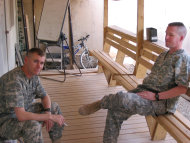
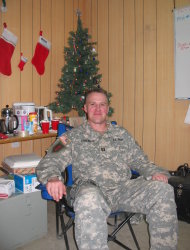
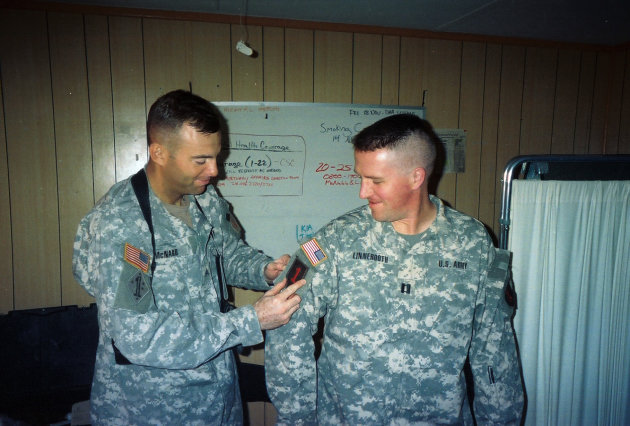
Vet who saved many in Iraq couldn't escape demons By SHARON COHEN | Associated Press – 15 hrs ago Email Share3108 14 Print In this Autumn 2006 photo provided by Brock McNabb, McNabb places a "combat patch" on Pete Linnerooth's uniform at their office in Baghdad, denoting that he had been in-country long enough to earn the badge of honor and is officially a combat veteran. Capt. Linnerooth was an Army psychologist who counseled soldiers during some of the fiercest fighting in Iraq. Hundreds upon hundreds sought his help. For nightmares and insomnia. For shock and grief. And for reaching that point where they just wanted to end it all. Linnerooth did such a good job his Army comrades dubbed him The Wizard. His "magic" was deceptively simple: an instant rapport with soldiers, an empathetic manner, a big heart. (AP Photo/Brock McNabb) View Photo Associated Press/Brock McNabb - In this Autumn 2006 photo provided by Brock McNabb, McNabb places a "combat patch" on Pete Linnerooth's uniform at their office in Baghdad, denoting that he had been in-country …more Related Content This 2007 photo provided by Brock McNabb shows Pete Linnerooth, right, and Travis Landchild sitting outside their mental health clinic in Baghdad. McNabb, Landchild and Linnerooth were the tight-knit mental health crew in charge of the 2nd Brigade Combat Team, 1st Infantry Division in the Baghdad area. They were there when the surge began, rocket attacks increased and the death toll mounted. Fairchild says the three dubbed themselves "a dysfunctional tripod." Translation: One of the three 'legs' was always broken, or stressed out, and without fail, "the other two would step up and support that person." (AP Photo/Brock McNabb)View Photo This 2007 photo provided by Brock … This Dec. 15, 2006 photo provided by Brock McNabb shows Pete Linnerooth in their Christmas-decorated office in Baghdad, Iraq. Capt. Linnerooth, an Army psychologist, counseled soldiers during some of the fiercest fighting in Iraq. (AP Photo/Brock McNabb)View Photo This Dec. 15, 2006 photo provided … He had a knack for soothing soldiers who'd just seen their buddies killed by bombs. He knew how to comfort medics sickened by the smell of blood and troops haunted by the screams of horribly burned Iraqi children. Capt. Peter Linnerooth was an Army psychologist. He counseled soldiers during some of the fiercest fighting in Iraq. Hundreds upon hundreds sought his help. For nightmares and insomnia. For shock and grief. And for reaching that point where they just wanted to end it all. Linnerooth did such a good job his Army comrades dubbed him The Wizard. His "magic" was deceptively simple: an instant rapport with soldiers, an empathetic manner, a big heart. For a year during one of the bloodiest stretches of the Iraq war, Linnerooth met with soldiers 60 to 70 hours a week. Sometimes he'd hop on helicopters or join convoys, risking mortars and roadside bombs. Often, though, the soldiers came to his shoebox-sized "office" at Camp Liberty in Baghdad. There they'd encounter a raspy-voiced, broad-shouldered guy who blasted Motorhead, Iron Maiden and other ear-shattering heavy metal, favored four-letter words and inhaled Marlboro Reds — once even while conducting a "stop smoking" class. He was THAT persuasive. Linnerooth knew when to be a friend and when to be a professional Army officer. He could be tough, even gruff at times, but he also was a gentle soul, a born storyteller, a proud dad who decorated his quarters with his kids' drawings and photos. He carried his newborn daughter's shoes on his ruck sack for good luck. Linnerooth left Iraq in 2007, a few months short of the end of his 15-month tour. He couldn't take it anymore. He'd heard enough terrible stories. He'd seen enough dead and dying. He became a college professor in Minnesota, then counseled vets in California and Nevada. He'd done much to help the troops, but in his mind, it wasn't enough. He worried about veteran suicides. He wrote about professional burnout. He grappled with PTSD, depression and anger, his despair spiraling into an overdose. He divorced and married again. He fought valiantly to get his life in order. But he couldn't make it happen. As the new year dawned, Pete Linnerooth, Bronze Star recipient, admired Army captain, devoted father, turned his gun on himself. He was 42. He was, as one buddy says, the guy who could help everybody — everybody but himself. ___ He liked to jokingly compare himself to an intrepid explorer stranded in one of the most remote corners of the earth. Linnerooth's best buddy, Brock McNabb, recalls how they'd laugh and find parallels to the plight of Ernest Shackleton, whose ship, Endurance, became trapped in the Antarctic during an early 20th-century expedition. The crew ended up on an ice floe, scrambling to survive. This was the 100-degree desert, of course, but for them, the analogy was apt: Both were impossible missions — Linnerooth and two teammates were responsible for the mental stability and psychological care of thousands — and both groups leaned on one another for emotional sustenance. "There's no cavalry to save the day," McNabb explains. "You ARE the cavalry. There was no relief." McNabb and a third soldier, Travis Landchild, were the tight-knit mental health crew in charge of the 2nd Brigade Combat Team, 1st Infantry Division in the Baghdad area. They were there when the surge began, rocket attacks increased and the death toll mounted. Landchild says the three dubbed themselves "a dysfunctional tripod." Translation: One of the three "legs" was always broken, or stressed out, and without fail, "the other two would step up and support that person." A few months into their tour, McNabb says, both he and Linnerooth — with the approval of on-site doctors — began taking antidepressants. "He had to have training wheels," McNabb says. "We all did." They worked non-stop, even overnight sometimes. They listened so intently, their nightmares were not their own. They saw guys who'd witnessed Humvees vaporize before them, medics barely out of high school dealing with double amputations, women sexually assaulted in combat zones. There were soldiers suffering from paranoia, bipolar disorder, anxiety — one was wetting his bed. And then there were those escorted under guard after threatening suicide. "People are in rough, rough shape ... it's misery all the time, and it does affect you," McNabb says. Linnerooth — the only trained psychologist of the three — was frustrated by what he regarded as the Army's view of mental health as a second-class problem that can be minimized or overlooked during deployment, McNabb says. At times, he also felt powerless — stabilizing soldiers, then having to return them to missions, knowing they'd be traumatized again. "Sometimes he felt he was putting a Band-Aid over a bullet hole," McNabb says. "It would be, 'I got you to where you can sleep through the night ... but guess what? You have seven months left in your deployment.'" For about half his tour, Linnerooth's office was a 12-by-12 trailer. His heavy-metal soundtrack — he banned the Beatles and Pink Floyd, deeming them too sad — provided a sound buffer. A thermal blanket serving as a makeshift room divider also provided a modicum of privacy. Linnerooth brought hope to those gripped by hopelessness. In a desert, he could always find the glass half full. He turned tragedies into cathartic moments: When a platoon lost a member, he'd encourage the survivors to deal with their grief by writing letters to the children of the fallen soldier, recounting the great things about their father. He used irreverence as a balm: When he met with troops in a chapel after a suicide bomb intended for them instead struck a group of Iraqi schoolgirls, he punctuated his remarks with a four-letter word. God, he insisted, surely wouldn't mind him cussing in a religious sanctuary, all things considered. Then he offered comfort. "It IS horrible," McNabb quotes him as saying. "'There are bad guys out there ... 'You're brave soldiers. You're being asked to do a job no one could do.'" But Linnerooth wasn't just dealing with emotional trauma. He was in the same complex as the busy Riva Ridge Troop Medical Clinic. When mass casualties arrived, he was there squeezing IV bags, handling bandages. Later on, talking with family, he'd hint of the horror in sketchy details, describing how a blocked drain once left the soldiers ankle-deep in blood, or the agony of Iraqi kids dying slowly. Linnerooth did elaborate in one essay. In words both graphic and incredibly tender, he described a female soldier brought in with mortal wounds. Her Humvee, while on a rescue mission, had been struck by an armor-penetrating explosive. "I stood at her head and considered her hair, for Christsakes!" he wrote. "The blast had mussed her hair. Removed her foot, cleaved her abdomen, but mussed her hair. For whatever reason I looked at it and longed to smooth it back from her forehead. Like I do for my children. It was reddish-blond, curly, almost kinky, and in disarray. I looked around me to see if anyone would notice this gesture, if anyone would mind. Hell, I don't know what to do in an abattoir of human suffering, it's not my job. I deal with easy things, like the paranoid, the personality disordered, and those without hope. All I wanted to do was smooth her hair, perhaps compose her for the next stage of her journey. But I never did it, and regret it to this day." ___ Even as he continued to comfort others, Linnerooth was showing signs of strain. Ray Nixon, then a medic at Riva Ridge, remembers anguishing over critical decisions — assigning soldiers to what could be life-and-death missions — and talking with Linnerooth. "Pete would always tell me, 'You're doing the best job you can. You're well trained,'" Nixon says. "He always made me feel better. He knew exactly what to say, exactly what direction to guide you in — but Pete was very bad at taking care of himself. Any time he was having problems or getting overwhelmed, instead of asking for help, he'd lock himself in his room and try to deal with it alone." He had always been this way. His mother, Gayle McMullen, who adopted Pete when he was 9½ weeks old, recalls a loving little boy who adored animals, talked up a storm at 18 months old and was very sensitive. He clammed up when upset. "You could see something was bothering him, but he kept a lot inside," she says. In Iraq, Linnerooth avoided socializing. Friends, he'd say, were potential patients. His buddies gave him space, but they noticed he wasn't bouncing back as he had before. A year into the tour, McNabb says, Linnerooth walked in a doctor's office and said: "'I can't stand it. This is too much. How much more misery and torture are these kids going to go through?'" The doctor, McNabb says, asked if he might hurt himself. Linnerooth replied he wasn't sure. As he was evacuated, he told McNabb he was crushed having to abandon his teammates. They saw it otherwise. "We didn't know if any of us were going to get out alive. You never do in war," Landchild says. "We kind of had this hope that one of us made it. Yeah, he's broken as heck and he has a lot of healing to do but he got OUT." ___ He wasn't the same. His family noticed it when they met him in Schweinfurt, Germany. "He came home burdened," says his younger sister, Mary Linnerooth Gonzalez. "He was disappointed that he couldn't affect the wheels of change. ... I think he was defeated." Amy, Linnerooth's wife at the time — they'd met as teens in Rochester, Minn. — says they had trouble resuming their lives. He didn't discuss what he'd seen while in Iraq, and didn't open up at home. "I think it was just kind of like a wall that he put up," she says. "I asked him about that later and he said if he let that guard down, then it would be like a dam flooding and it would just all come out and he couldn't be that way." There were some early warning signs, she says, including jokes about suicide. She dismissed it as gallows humor. In 2008, after nearly six years in the Army, Linnerooth was a civilian again, returning to an academic world where he'd thrived. He was the kind of student professors rave about for years, describing him as "brilliant" and "amazing." Patrick Friman, who was in charge of Linnerooth's doctoral dissertation at the University of Nevada-Reno, remembers a day when his then-student joined him for training at an out-patient psychological clinic. A mother was struggling with her 3-year-old: The girl wouldn't sleep in her own bed, wasn't toilet trained and refused to do what her mother asked. It soon became clear that Linnerooth, the novice, was much better at relating to the mother than the trained professor. "I marveled at how well he described the problem, the solution and the steps that need to be taken to achieve it," Friman says. "She was hanging on his every word. She couldn't wait to go home to try it." Linnerooth recommended the mother set reasonable bed times, be affectionate when her child was behaving and make other adjustments. The plan succeeded. "He wanted to learn how to work with kids and he was just a natural at it," Friman says. Linnerooth also had made an impression at Minnesota State University-Mankato, where he earned his master's degree. Professor Daniel Houlihan, who was his adviser, remembers an enormously gifted writer who was prescient about the war — years before, he had warned of a high military suicide rate. He was hired to teach psychology at the school in 2008. Still raw from Iraq, he quickly became annoyed with 19 year olds griping about tough grading standards. He'd just come from a place where 19 year olds worried about their very survival. Linnerooth began missing meetings. He seemed paranoid, spending a lot of time in his office shredding papers, Houlihan recalls. Jeffrey Buchanan, another professor in Mankato who'd been friends with Linnerooth and his wife since grad school, says the confident, self-assured Pete was gone. "It seemed like he was questioning every decision he was making," he says. Things were also bad at home. Amy Linnerooth says they tried marital counseling. Her husband seemed two people, she says. "It would be like the guy you knew ... then a little thing would set him off," she recalls. "I remember telling him 'I just want to blend in with the wallpaper. I don't want to be in your way.' It was like walking on eggshells." In early 2009, Linnerooth's depression took a disastrous turn. He nearly died from an overdose of pills. His buddy, McNabb, phoned. "Jesus, man you can't even kill yourself right," he teased. Linnerooth laughed. But he also confided: "I just hated where my life was going. Here, I'm arguing with my wife. ... I want to be normal for my kids. ... I was tired of being here.'" Amy Linnerooth says her husband was very remorseful. "He thought that was a really stupid thing to do to the kids and us," she says. She was convinced he'd never try to harm himself again. By late 2009, though, his marriage was failing and his job was in jeopardy. Houlihan, his colleague, approached him. "This just isn't working well," he said. "We've got to figure out how we can salvage your career." The professor expected Linnerooth to be defensive. Instead, he was relieved to confront the problems. He was given an extended leave and headed west to start a new life. ____ McNabb had invited his pal to him join him at the Santa Cruz County Vet Center in California. He arrived looking terrible, but soon shed 50 pounds and shaved his long beard. He moved in across the street from McNabb. They spent nights chatting over beers. Linnerooth liked his new surroundings but his ongoing divorce and separation from his kids weighed on him. Still, he remained an attentive, loving father. He'd fly to Minnesota often and while in California, he'd call his children, Jack, 9, and Whitney, 6, every night. He'd read to his son; he created a cartoon series for his daughter featuring a spider they called Gigerenzer. He'd Skype with his kids, too, content just to watch them watch TV. Linnerooth also felt his work as a veterans' readjustment counselor was helping people. He spoke at symposiums about the emotional trauma of war. With McNabb, he conducted a suicide prevention class for an Army Reserve unit, even as he himself was being treated for his own PTSD. He became more vocal about the strains on military psychologists. Linnerooth talked about the pressures to The New York Times and Time. He told the magazine in 2010 "the Army has been criminally negligent," in not having enough mental health experts to serve combat vets, putting a bigger burden on those trying to do the job. He joined Bret Moore, another former Army psychologist he befriended before Iraq, to produce an academic paper about professional burnout. "He wanted to write and get the word out," Moore says. "It was therapeutic for him. ... He really was putting his heart and soul into it." For a time, Linnerooth seemed happy, telling Moore about his budding relationship with Melanie Walsh, a social worker. They'd met a decade earlier when she was an undergraduate assistant at Reno. Moore was invited to their July 2011 wedding in Lake Tahoe. As the months wore on, though, he reported marital strains. He also was missing deadlines for their paper. Moore says he eventually toned down Linnerooth's work to make it more academic and less emotional. "You could really see the anger," he says, noting it reflected both his attitude toward the military and his disintegrating personal life. The paper was published in 2011 in an American Psychological Association journal. Linnerooth moved to Reno to be with his new wife. He was hired by the Department of Veterans Affairs to work with vets struggling with PTSD and substance abuse. There was a hitch, though. He was approaching a two-year deadline to get a state license required by the VA. McNabb urged him to take the test. Whether it was depression or another reason, he didn't. The VA let him go. (The agency said in a January statement that it was forced to terminate Linnerooth because of the lack of licensing but offered to take him back once he finished the requirements.) "He felt betrayed," his widow says. "He deteriorated after that and he deteriorated quickly." "It broke him yet again," his sister says. "He felt let down by the system." Even for "a fairly resilient guy," Moore says, "there was just one letdown right after the other. He never got any breathing room." ___ At the end of last summer, Linnerooth returned home to Minnesota so he could see his children daily. He did travel back to California, though, for a joyous occasion — the birth of his son, David. He spoke often with his buddy, McNabb, and seemed optimistic, considering new careers outside psychology But he kept his distance, too, not telling former university colleagues he was back. Linnerooth was busy with family during the holidays: He sent his mother a text thanking her for the kids' Christmas gifts, traveled west to see his baby and sent photos of the infant in a green monster outfit to his sister, Mary. On Jan. 1, he spent a happy day with his son, Jack, and was planning another visit with David. The next day, though, McNabb says, a fight with his wife, alcohol and a loaded gun proved a tragic combination. He left a note with instructions, but no explanation of why he'd taken his life. "For the record, Pete Linnerooth did not want to die," McNabb says. "He just wanted the pain to end. Big difference." For all those who loved and admired him, for all those who saw him at his best and worst, these past weeks have been filled with sorrow, regret and inescapable irony. "He didn't like to burden other people," his widow says. "He liked to take care of other people. I don't know anyone who knew how to comfort people like he did. ... He was very kind. He was sincere. He was generous. He was patient. He was forgiving. It's such a tragedy. He had the skill, he genuinely cared and he could have helped so many people. And now he's gone." ___ His family and friends gathered on a bitter cold January day in Minnesota to bid farewell. The night before, his Army pals flew in from around the country and toasted their buddy with prodigious amounts of scotch and rum. They shared favorite Pete stories and placed his urn on the table, covering it with a Motorhead T-shirt. Later in the hotel room near Fort Snelling National Cemetery, McNabb mulled over how to leave a legacy for his friend's kids — a memorial that would give them peace and make them proud. But he was limited to 30 characters for the message on Pete's headstone. How do you honor a life in a handful of words? McNabb then remembered something Linnerooth had once told him: "Maybe we're all meant for just one great deed and we're done." That gave him an idea. The next day, on a 4-degree, cloudless morning, Capt. Peter J.N. Linnerooth was laid to rest with taps and a 21-gun salute. McNabb presented Linnerooth's son, Jack, with his father's Bronze Star, telling him: "Don't forget your dad was so very proud of you." After the mourners met for lunch and more reminiscences, a small group of Army friends who'd served with him in Iraq returned to the unmarked stone as the sun lowered in the winter sky. McNabb leaned over a long arm, tapped the marble and addressed Pete: "You owe me a ---- ton of beers when I see you next," he said with a smile. Then he surveyed the surrounding graves, calling out to Pete those buried nearby, when they served and in what branch of military. These were now his neighbors. "You're with all these people who'll love you for all time," he said. It was finally time to go. On a February day, the engraved headstone arrived. It's etched with Peter Linnerooth's name, his military service and a tribute to his great deed, summed up in this spare epitaph: HE SAVED MANY NOW HE'S HOME. ___ Sharon Cohen is a Chicago-based national writer. She can be reached at scohen(at)ap.org.
Vet who saved many in Iraq couldn't escape demons

He had a knack for soothing soldiers who'd just seen their buddies killed by bombs. He knew how to comfort medics sickened by the smell of blood and troops haunted by the screams of horribly burned Iraqi children.
Capt. Peter Linnerooth was an Army psychologist. He counseled soldiers during some of the fiercest fighting in Iraq. Hundreds upon hundreds sought his help. For nightmares and insomnia. For shock and grief. And for reaching that point where they just wanted to end it all.
Linnerooth did such a good job his Army comrades dubbed him The Wizard. His "magic" was deceptively simple: an instant rapport with soldiers, an empathetic manner, a big heart.
For a year during one of the bloodiest stretches of the Iraq war, Linnerooth met with soldiers 60 to 70 hours a week. Sometimes he'd hop on helicopters or join convoys, risking mortars and roadside bombs. Often, though, the soldiers came to his shoebox-sized "office" at Camp Liberty in Baghdad.
There they'd encounter a raspy-voiced, broad-shouldered guy who blasted Motorhead, Iron Maiden and other ear-shattering heavy metal, favored four-letter words and inhaled Marlboro Reds — once even while conducting a "stop smoking" class. He was THAT persuasive.
Linnerooth knew when to be a friend and when to be a professional Army officer. He could be tough, even gruff at times, but he also was a gentle soul, a born storyteller, a proud dad who decorated his quarters with his kids' drawings and photos. He carried his newborn daughter's shoes on his ruck sack for good luck.
Linnerooth left Iraq in 2007, a few months short of the end of his 15-month tour. He couldn't take it anymore. He'd heard enough terrible stories. He'd seen enough dead and dying.
He became a college professor in Minnesota, then counseled vets in California and Nevada. He'd done much to help the troops, but in his mind, it wasn't enough. He worried about veteran suicides. He wrote about professional burnout. He grappled with PTSD, depression and anger, his despair spiraling into an overdose. He divorced and married again. He fought valiantly to get his life in order.
But he couldn't make it happen.
As the new year dawned, Pete Linnerooth, Bronze Star recipient, admired Army captain, devoted father, turned his gun on himself. He was 42.
He was, as one buddy says, the guy who could help everybody — everybody but himself.
___
He liked to jokingly compare himself to an intrepid explorer stranded in one of the most remote corners of the earth.
Linnerooth's best buddy, Brock McNabb, recalls how they'd laugh and find parallels to the plight of Ernest Shackleton, whose ship, Endurance, became trapped in the Antarctic during an early 20th-century expedition. The crew ended up on an ice floe, scrambling to survive.
This was the 100-degree desert, of course, but for them, the analogy was apt: Both were impossible missions — Linnerooth and two teammates were responsible for the mental stability and psychological care of thousands — and both groups leaned on one another for emotional sustenance.
"There's no cavalry to save the day," McNabb explains. "You ARE the cavalry. There was no relief."
McNabb and a third soldier, Travis Landchild, were the tight-knit mental health crew in charge of the 2nd Brigade Combat Team, 1st Infantry Division in the Baghdad area. They were there when the surge began, rocket attacks increased and the death toll mounted.
Landchild says the three dubbed themselves "a dysfunctional tripod." Translation: One of the three "legs" was always broken, or stressed out, and without fail, "the other two would step up and support that person."
A few months into their tour, McNabb says, both he and Linnerooth — with the approval of on-site doctors — began taking antidepressants. "He had to have training wheels," McNabb says. "We all did."
They worked non-stop, even overnight sometimes. They listened so intently, their nightmares were not their own.
They saw guys who'd witnessed Humvees vaporize before them, medics barely out of high school dealing with double amputations, women sexually assaulted in combat zones. There were soldiers suffering from paranoia, bipolar disorder, anxiety — one was wetting his bed. And then there were those escorted under guard after threatening suicide.
"People are in rough, rough shape ... it's misery all the time, and it does affect you," McNabb says.
Linnerooth — the only trained psychologist of the three — was frustrated by what he regarded as the Army's view of mental health as a second-class problem that can be minimized or overlooked during deployment, McNabb says. At times, he also felt powerless — stabilizing soldiers, then having to return them to missions, knowing they'd be traumatized again.
"Sometimes he felt he was putting a Band-Aid over a bullet hole," McNabb says. "It would be, 'I got you to where you can sleep through the night ... but guess what? You have seven months left in your deployment.'"
For about half his tour, Linnerooth's office was a 12-by-12 trailer. His heavy-metal soundtrack — he banned the Beatles and Pink Floyd, deeming them too sad — provided a sound buffer. A thermal blanket serving as a makeshift room divider also provided a modicum of privacy.
Linnerooth brought hope to those gripped by hopelessness. In a desert, he could always find the glass half full.
He turned tragedies into cathartic moments: When a platoon lost a member, he'd encourage the survivors to deal with their grief by writing letters to the children of the fallen soldier, recounting the great things about their father.
He used irreverence as a balm: When he met with troops in a chapel after a suicide bomb intended for them instead struck a group of Iraqi schoolgirls, he punctuated his remarks with a four-letter word. God, he insisted, surely wouldn't mind him cussing in a religious sanctuary, all things considered. Then he offered comfort.
"It IS horrible," McNabb quotes him as saying. "'There are bad guys out there ... 'You're brave soldiers. You're being asked to do a job no one could do.'"
But Linnerooth wasn't just dealing with emotional trauma. He was in the same complex as the busy Riva Ridge Troop Medical Clinic. When mass casualties arrived, he was there squeezing IV bags, handling bandages.
Later on, talking with family, he'd hint of the horror in sketchy details, describing how a blocked drain once left the soldiers ankle-deep in blood, or the agony of Iraqi kids dying slowly.
Linnerooth did elaborate in one essay. In words both graphic and incredibly tender, he described a female soldier brought in with mortal wounds. Her Humvee, while on a rescue mission, had been struck by an armor-penetrating explosive.
"I stood at her head and considered her hair, for Christsakes!" he wrote. "The blast had mussed her hair. Removed her foot, cleaved her abdomen, but mussed her hair. For whatever reason I looked at it and longed to smooth it back from her forehead. Like I do for my children. It was reddish-blond, curly, almost kinky, and in disarray. I looked around me to see if anyone would notice this gesture, if anyone would mind. Hell, I don't know what to do in an abattoir of human suffering, it's not my job. I deal with easy things, like the paranoid, the personality disordered, and those without hope. All I wanted to do was smooth her hair, perhaps compose her for the next stage of her journey. But I never did it, and regret it to this day."
___
Even as he continued to comfort others, Linnerooth was showing signs of strain.
Ray Nixon, then a medic at Riva Ridge, remembers anguishing over critical decisions — assigning soldiers to what could be life-and-death missions — and talking with Linnerooth.
"Pete would always tell me, 'You're doing the best job you can. You're well trained,'" Nixon says. "He always made me feel better. He knew exactly what to say, exactly what direction to guide you in — but Pete was very bad at taking care of himself. Any time he was having problems or getting overwhelmed, instead of asking for help, he'd lock himself in his room and try to deal with it alone."
He had always been this way. His mother, Gayle McMullen, who adopted Pete when he was 9½ weeks old, recalls a loving little boy who adored animals, talked up a storm at 18 months old and was very sensitive. He clammed up when upset. "You could see something was bothering him, but he kept a lot inside," she says.
In Iraq, Linnerooth avoided socializing. Friends, he'd say, were potential patients.
His buddies gave him space, but they noticed he wasn't bouncing back as he had before.
A year into the tour, McNabb says, Linnerooth walked in a doctor's office and said: "'I can't stand it. This is too much. How much more misery and torture are these kids going to go through?'"
The doctor, McNabb says, asked if he might hurt himself. Linnerooth replied he wasn't sure.
As he was evacuated, he told McNabb he was crushed having to abandon his teammates. They saw it otherwise.
"We didn't know if any of us were going to get out alive. You never do in war," Landchild says. "We kind of had this hope that one of us made it. Yeah, he's broken as heck and he has a lot of healing to do but he got OUT."
___
He wasn't the same. His family noticed it when they met him in Schweinfurt, Germany.
"He came home burdened," says his younger sister, Mary Linnerooth Gonzalez. "He was disappointed that he couldn't affect the wheels of change. ... I think he was defeated."
Amy, Linnerooth's wife at the time — they'd met as teens in Rochester, Minn. — says they had trouble resuming their lives. He didn't discuss what he'd seen while in Iraq, and didn't open up at home.
"I think it was just kind of like a wall that he put up," she says. "I asked him about that later and he said if he let that guard down, then it would be like a dam flooding and it would just all come out and he couldn't be that way."
There were some early warning signs, she says, including jokes about suicide. She dismissed it as gallows humor.
In 2008, after nearly six years in the Army, Linnerooth was a civilian again, returning to an academic world where he'd thrived.
He was the kind of student professors rave about for years, describing him as "brilliant" and "amazing."
Patrick Friman, who was in charge of Linnerooth's doctoral dissertation at the University of Nevada-Reno, remembers a day when his then-student joined him for training at an out-patient psychological clinic. A mother was struggling with her 3-year-old: The girl wouldn't sleep in her own bed, wasn't toilet trained and refused to do what her mother asked.
It soon became clear that Linnerooth, the novice, was much better at relating to the mother than the trained professor. "I marveled at how well he described the problem, the solution and the steps that need to be taken to achieve it," Friman says. "She was hanging on his every word. She couldn't wait to go home to try it."
Linnerooth recommended the mother set reasonable bed times, be affectionate when her child was behaving and make other adjustments. The plan succeeded. "He wanted to learn how to work with kids and he was just a natural at it," Friman says.
Linnerooth also had made an impression at Minnesota State University-Mankato, where he earned his master's degree. Professor Daniel Houlihan, who was his adviser, remembers an enormously gifted writer who was prescient about the war — years before, he had warned of a high military suicide rate.
He was hired to teach psychology at the school in 2008. Still raw from Iraq, he quickly became annoyed with 19 year olds griping about tough grading standards. He'd just come from a place where 19 year olds worried about their very survival.
Linnerooth began missing meetings. He seemed paranoid, spending a lot of time in his office shredding papers, Houlihan recalls.
Jeffrey Buchanan, another professor in Mankato who'd been friends with Linnerooth and his wife since grad school, says the confident, self-assured Pete was gone. "It seemed like he was questioning every decision he was making," he says.
Things were also bad at home. Amy Linnerooth says they tried marital counseling.
Her husband seemed two people, she says. "It would be like the guy you knew ... then a little thing would set him off," she recalls. "I remember telling him 'I just want to blend in with the wallpaper. I don't want to be in your way.' It was like walking on eggshells."
In early 2009, Linnerooth's depression took a disastrous turn. He nearly died from an overdose of pills.
His buddy, McNabb, phoned.
"Jesus, man you can't even kill yourself right," he teased. Linnerooth laughed.
But he also confided: "I just hated where my life was going. Here, I'm arguing with my wife. ... I want to be normal for my kids. ... I was tired of being here.'"
Amy Linnerooth says her husband was very remorseful. "He thought that was a really stupid thing to do to the kids and us," she says. She was convinced he'd never try to harm himself again.
By late 2009, though, his marriage was failing and his job was in jeopardy.
Houlihan, his colleague, approached him. "This just isn't working well," he said. "We've got to figure out how we can salvage your career."
The professor expected Linnerooth to be defensive. Instead, he was relieved to confront the problems.
He was given an extended leave and headed west to start a new life.
____
McNabb had invited his pal to him join him at the Santa Cruz County Vet Center in California.
He arrived looking terrible, but soon shed 50 pounds and shaved his long beard. He moved in across the street from McNabb. They spent nights chatting over beers.
Linnerooth liked his new surroundings but his ongoing divorce and separation from his kids weighed on him. Still, he remained an attentive, loving father. He'd fly to Minnesota often and while in California, he'd call his children, Jack, 9, and Whitney, 6, every night. He'd read to his son; he created a cartoon series for his daughter featuring a spider they called Gigerenzer. He'd Skype with his kids, too, content just to watch them watch TV.
Linnerooth also felt his work as a veterans' readjustment counselor was helping people. He spoke at symposiums about the emotional trauma of war. With McNabb, he conducted a suicide prevention class for an Army Reserve unit, even as he himself was being treated for his own PTSD.
He became more vocal about the strains on military psychologists. Linnerooth talked about the pressures to The New York Times and Time. He told the magazine in 2010 "the Army has been criminally negligent," in not having enough mental health experts to serve combat vets, putting a bigger burden on those trying to do the job.
He joined Bret Moore, another former Army psychologist he befriended before Iraq, to produce an academic paper about professional burnout. "He wanted to write and get the word out," Moore says. "It was therapeutic for him. ... He really was putting his heart and soul into it."
For a time, Linnerooth seemed happy, telling Moore about his budding relationship with Melanie Walsh, a social worker. They'd met a decade earlier when she was an undergraduate assistant at Reno. Moore was invited to their July 2011 wedding in Lake Tahoe.
As the months wore on, though, he reported marital strains. He also was missing deadlines for their paper.
Moore says he eventually toned down Linnerooth's work to make it more academic and less emotional. "You could really see the anger," he says, noting it reflected both his attitude toward the military and his disintegrating personal life. The paper was published in 2011 in an American Psychological Association journal.
Linnerooth moved to Reno to be with his new wife. He was hired by the Department of Veterans Affairs to work with vets struggling with PTSD and substance abuse.
There was a hitch, though. He was approaching a two-year deadline to get a state license required by the VA.
McNabb urged him to take the test. Whether it was depression or another reason, he didn't. The VA let him go. (The agency said in a January statement that it was forced to terminate Linnerooth because of the lack of licensing but offered to take him back once he finished the requirements.)
"He felt betrayed," his widow says. "He deteriorated after that and he deteriorated quickly."
"It broke him yet again," his sister says. "He felt let down by the system."
Even for "a fairly resilient guy," Moore says, "there was just one letdown right after the other. He never got any breathing room."
___
At the end of last summer, Linnerooth returned home to Minnesota so he could see his children daily. He did travel back to California, though, for a joyous occasion — the birth of his son, David.
He spoke often with his buddy, McNabb, and seemed optimistic, considering new careers outside psychology But he kept his distance, too, not telling former university colleagues he was back.
Linnerooth was busy with family during the holidays: He sent his mother a text thanking her for the kids' Christmas gifts, traveled west to see his baby and sent photos of the infant in a green monster outfit to his sister, Mary. On Jan. 1, he spent a happy day with his son, Jack, and was planning another visit with David.
The next day, though, McNabb says, a fight with his wife, alcohol and a loaded gun proved a tragic combination.
He left a note with instructions, but no explanation of why he'd taken his life.
"For the record, Pete Linnerooth did not want to die," McNabb says. "He just wanted the pain to end. Big difference."
For all those who loved and admired him, for all those who saw him at his best and worst, these past weeks have been filled with sorrow, regret and inescapable irony.
"He didn't like to burden other people," his widow says. "He liked to take care of other people. I don't know anyone who knew how to comfort people like he did. ... He was very kind. He was sincere. He was generous. He was patient. He was forgiving. It's such a tragedy. He had the skill, he genuinely cared and he could have helped so many people. And now he's gone."
___
His family and friends gathered on a bitter cold January day in Minnesota to bid farewell.
The night before, his Army pals flew in from around the country and toasted their buddy with prodigious amounts of scotch and rum. They shared favorite Pete stories and placed his urn on the table, covering it with a Motorhead T-shirt.
Later in the hotel room near Fort Snelling National Cemetery, McNabb mulled over how to leave a legacy for his friend's kids — a memorial that would give them peace and make them proud. But he was limited to 30 characters for the message on Pete's headstone. How do you honor a life in a handful of words?
McNabb then remembered something Linnerooth had once told him: "Maybe we're all meant for just one great deed and we're done."
That gave him an idea.
The next day, on a 4-degree, cloudless morning, Capt. Peter J.N. Linnerooth was laid to rest with taps and a 21-gun salute.
McNabb presented Linnerooth's son, Jack, with his father's Bronze Star, telling him: "Don't forget your dad was so very proud of you."
After the mourners met for lunch and more reminiscences, a small group of Army friends who'd served with him in Iraq returned to the unmarked stone as the sun lowered in the winter sky.
McNabb leaned over a long arm, tapped the marble and addressed Pete:
"You owe me a ---- ton of beers when I see you next," he said with a smile.
Then he surveyed the surrounding graves, calling out to Pete those buried nearby, when they served and in what branch of military. These were now his neighbors.
"You're with all these people who'll love you for all time," he said.
It was finally time to go.
On a February day, the engraved headstone arrived. It's etched with Peter Linnerooth's name, his military service and a tribute to his great deed, summed up in this spare epitaph:
HE SAVED MANY
NOW HE'S HOME.
___
Sharon Cohen is a Chicago-based national writer. She can be reached at scohen(at)ap.org.

Thursday, February 28, 2013

The wedding shots you really should have

Newlywed couple posing for wedding photographerNewlywed couple posing for wedding photographer

Before the wedding

While everyone is busy getting ready for the ceremony, there can be some special moments which can easily be missed. Be sure to ask the photographer to capture the following moments, or pass your camera around your bridal entourage to ensure there are photos of everyone.
  • Bride getting ready with mother.
  • Bridesmaids.
  • Relatives.
  • Bride and bridesmaids putting on makeup/having their hair done.
  • Bride and parents leaving for ceremony.
  • Groom getting ready.
  • Groom doing up his tie.
  • Groom and best man.
  • Groom with parents.

At the wedding prior to the ceremony

While the guests arrive and everyone is anticipating the arrival of the bride, it's a good idea to capture this special atmosphere, particularly as this is something the bride herself won't experience. Try and get some relaxed shots of the following:
  • Guests arriving at the ceremony.
  • Bridesmaids’ and Bride’s arrival.
  • Groom’s arrival.
  • Chief bridesmaid walking down the aisle.
  • Bridesmaids walking down the aisle.
  • Flower girl and ring bearer walking down aisle.
  • Groom waiting for bride.
  • Ceremony musicians or choir.
  • Wedding official.
  • Close up of bride just before entering.

At the wedding ceremony

At this stage, the photographer will need to be their most discreet, but it's a great opportunity to capture the main moments of the day. Consider requesting the following images to be taken:
  • Bride and father walking down the aisle.
  • Bride and father walking down the aisle (back shot) – with the groom ahead in the distance.
  • Bride and groom saying their vows, and then looking in to one another' eyes.
  • Exchange of the rings.
  • Close up of their hands.
  • The first kiss as a married couple.
  • Married couple signing the marriage certificate.
  • Bride and groom walking up the aisle.
  • Bride and groom as soon as they emerge from the ceremony.
  • Guests throwing confetti or equivalent over the couple.
  • Guests congratulating the couple -capture hugs, kisses and bride bending down to younger relatives.
  • Bride and groom getting in to their wedding car.
  • Bride and groom on the back seat of the wedding car, sipping champagne.
  • Couple being driven away and guests waving them off.

After the ceremony and the wedding reception

Now that the wedding party can begin to relax and enjoy the rest of the wedding day, it is a great opportunity to capture some fun and spontaneous shots. This is where the party starts and everyone enjoys a drink, so the photographer can be more creative and have a freer reign of the images. Consider capturing the following:
  • Bridal bouquet.
  • Groom portraits.
  • Bridal couple (full length and close shots).
  • Bride and her parents.
  • Groom and his parents.
  • Bridal couple with both sets of parents.
  • Bride with flower girl/ring bearer.
  • Bride with chief bridesmaid.
  • Bride with bridesmaids.
  • Bride with groomsmen.
  • Groom with best man.
  • Groom and his groomsmen.
  • Groom with bridesmaids.
  • Bride alone (full length).
  • Bride and groom with families.
  • Bride and groom with entire wedding party.

The wedding reception

  • Bridal couple arriving at reception venue.
  • Bride and groom greeting guests.
  • Table centrepieces.
  • Head table.
  • Musicians or DJ.
  • Guest book.
  • Wedding gifts.
  • Close up of bride and groom's place card.
  • The speeches.
  • Wedding cake and cutting of the cake.
  • Bride and groom with guests at each table.
  • Food shots.
  • First dance.
  • Groom and groom's mother dancing.
  • Father of the bride and bride dancing.
  • Various guests dancing.
  • Bride throwing bouquet.
  • Decorating the wedding couple's car.
  • Bride and groom driving away.
Read more on getwed.com...
Must-have wedding shots every guest should capture
10 alternative ways to arrive at your wedding
Follow getwed.com on Twitter

Saturday, February 9, 2013

The 5 best mirrorless cameras for travelers

Mirrorless cameras are the stuff of many traveler’s dreams. Having one means possessing a powerful tool in your hand without the hassle of extra baggage often experienced with bulky D-SLR cameras.

Even Nikon and Canon, who at first seemed cool toward mirrorless camera lines, have now decided to join the market. Nikon have already launched several series, while Canon recently introduced their EOS-M.

With so many choices in the market, you are probably wondering which one to choose as a travel companion. Our suggestion? Check the list below:

Olympus EPL-5
Using the same sensor as the Olympus OM-D, the EPL-5 delivers brilliant pictures. We also like its tilt-able touchscreen LCD. Its touch-LCD-to-take-a-photo feature is a strong candidate to win the hearts of many street photographers. The price is quite budget-friendly.
Effective pixels: 16.1 megapixels
Dimensions: 111 x 64 x 38 mm
Weight: 325 grams
Price: Rp 7,400,000 (US$ 765)  (with 14-42mm II R)


Canon EOS-M
If you already own a Canon SLR, you can save a lot of money by buying the Canon EOS-M to go with it since you don't have to do additional shopping for more lenses and accessories. Yes, it has dedicated lenses, but you can use your current EF and EF-S lenses for the EOS-M using the mount adapter EF-EOS M.
Effective pixels: 18 megapixels
Dimensions: 109 x 66 x 32 mm
Weight: 298 grams
Price: Rp 7,300,000 (US$ 755) (with EF-M 18-55mm)


Nikon 1 V1
Nikon decided to use a considerably smaller sensor compared to the ones usually used in other mirrorless cameras, making it-along with the lenses- a smaller and lighter product altogether. Oh, but we must regrettably mention that the Nikon 1 V1 uses a new mount and this means you won't be able to use your current lenses.
Effective pixels: 10.1 megapixels
Dimensions: 113 x 76 x 44 mm
Weight: 383 grams
Price: Rp 6,400,000 (US$661)  (with VR 10-30mm)


Panasonic Lumix DMC-GF5
Panasonic seems to have made it clear that its DMC-GF5 is not designed for enthusiasts. Instead, the mirrorless camera with APS-C sized sensor is aimed at compact digital camera owners wanting want to upgrade to a more reliable option. Not many control buttons are available on the body and menus are accessed through LCD. The GF5’s auto-focus system is quick and reliable but it lacks a flash hot shoe.
Effective pixels: 12.1 megapixels
Dimensions: 108 x 67 x 37 mm
Weight: 267 grams
Price: Rp 5,500,000 ($568) (with 14-42mm + 14mm)


Sony NEX-7
Looking for the top notch resolution mirrorless camera? Consider this option. The Sony NEX-7’s compact body houses the mighty 24.3 APS-C megapixel sensor and its features include a high resolution electronic viewfinder.
Effective pixels: 24.3 megapixel
Dimensions: 120 x 67 x 43 mm
Weight: 400 grams
Price: Rp 11,000,000 ($1,137) (body only)

Tuesday, February 5, 2013

Earl Grey descendants sell English tea to China

TRURO, England (Reuters) - An estate owned by descendants of the 19th century British aristocrat for whom Earl Grey tea was named is turning history on its head by selling English tea to China.
The Tregothnan estate in the southwestern English county of Cornwall started selling tea from its tiny plantation in 2005 and last year produced about 10 metric tons (11.023 tons) of tea and infusions.
Although a drop in the ocean of global tea production, which the UK Tea Council estimated to be about 4.3 million metric tons, Tregothnan has found a niche for its products by trading on England's historical reputation as a nation of tea-lovers.
"It's unique. There's no one else who's growing tea in England and putting English tea on the market," owner Evelyn Boscawen told Reuters.
The long history of immersing tea leaves in hot water for a refreshing drink is not lost on the son of the current Viscount Falmouth and a descendant of British Prime Minister Charles Grey, for whom the bergamot-flavored Earl Grey tea is named and whose Reform Act of 1832 sowed the seeds of modern parliamentary democracy and universal suffrage in Britain.
Chinese tea has been coming to Britain since the East India Company first imported it in the 17th century for consumption by wealthy aristocrats.
By the Victorian era, taking tea had become a regular ritual at almost every level of society from elaborate afternoon tea for the rich in country houses to tea and gruel for the working poor as depicted by author Charles Dickens.
But the Boscawens at Tregothnan are bucking the historic trend of tea flowing from East to West by beginning to export some of their wares to China and elsewhere.
"We do see China as an opportunity at the moment," Boscawen said. "The Chinese are great lovers of buying exotic things from all over the world. Even if it might have come from China (originally)."
Tea, native to Asia, is not traditionally grown in Britain but can be cultivated outdoors at Tregothnan, which is situated in England's southwest and benefits from an unusual microclimate similar to that of Darjeeling in India.
Less similar to India is the tiny scale of production at Tregothnan, which might be large enough to be considered a small Darjeeling tea garden, the English estate's commercial and garden director Jonathan Jones said.
"We went into this right from the outset as being able to put the English into English tea," Jones said. "We weren't ever looking at being the new India or China, that's ridiculous."
HIGH TEA
Tregothnan projected sales of teas and infusions of 2 million pounds ($3.14 million) in 2013, with 1 million pounds coming from exports.
This is a miniscule sum in comparison to the global export market, with the world's largest black tea exporter, Kenya, predicting tea exports earnings of $1.33 billion in 2013.
But the small English operation is attracting attention, including from Chinese state television, which pitched up for several days of filming for a program to be aired in the coming months to hundreds of millions of viewers.
Tregothnan is also hoping to open a franchise of tea houses named "Festival of Tea", selling tea in a coffee-house style. They plan to open one such outlet this year in Shanghai, after "serious interest from Chinese investors," Jones said.
The export market is also a place where Tregothnan hopes to find customers willing to meet its higher prices. Small-scale production and its location means its teas can cost up to 20 times as much per cup as the cheapest market blends.
"We're in recession, but other countries aren't, so it makes sense to export," general manager Andy Phillips said. "The key is not to get dragged into competing on price."
Tregothnan has targeted the high end of the market in Britain, selling some of its products to expensive hotels like the Savoy and Claridge's, which are already major tourist destinations for expensive English afternoon teas.
Referencing the stereotypical English love of a good brew is a big part of Tregothnan's marketing strategy.
"There is no trouble so great or grave that cannot be much diminished by a nice cup of tea," is the quote attributed to Basque philosopher Bernard-Paul Heroux that adorns individual packets containing the estate's tea bags.
With a portion of its tea bushes nestled in the estate's pleasure gardens, Tregothnan looks more like a vast country estate than an agricultural business, and its owners live on the site which has been the family home since 1335.
Tregothnan's historic setting, with its imposing country house and graceful grounds, is important for the brand.
"It's an enormous story that goes into the whole product," owner Boscawen said.
Tregothnan is part of a wider trend of small tea producers in strange parts of the world, according to Jane Pettigrew, a tea expert and author of several books on the subject.
"People are planting tea in the most extraordinary places at the moment," she said.
"There are people in Hawaii growing tea, there are people in Canada planting tea, and there are people up in Scotland planting tea."
($1 = 0.6367 British pounds)
(Reporting By Hannah Vinter, editing by Stephen Eisenhammer and Paul Casciato)

Tiger kills circus trainer in Mexico

Joe Fabello
You read this
An American tiger trainer was mauled and killed at a circus in Northwestern Mexico by one of the big cats performing with him, officials said Tuesday.
Amateur video showed Alex Crispin Suarez, 35, circling around two tigers and making the animals turn while standing on low platforms during a performance on Saturday in the Indian village of Etchojoa in Sonora state.
As he passed behind one of the tigers, it suddenly stopped the routine, knocked Crispin to the ground, pulled his pants off and clawed at his neck.
Shocked spectators were heard screaming as circus employees rushed to the scene. One hit the tiger repeatedly with a metal stand, but the animal would not let go of its prey.
Crispin was taken to hospital to receive treatment, but he died from the massive blood loss suffered in the attack.
Environmental protection prosecutors launched an investigation to determine the conditions at the circus under which the events occurred.
Authorities were focusing on the handling and display of 11 Bengal tigers, an elephant, three camels, 11 lamas and two pythons.

Saturday, February 2, 2013

By: David Cain / Source: Discover Your True Unique Life Path (take the free test)

Everyone gets drilled with certain lessons in life. Sometimes it takes repeated demonstrations of a given law of life to really get it into your skull, and other times one powerful experience drives the point home once, forever. Here are 88 things I’ve discovered about life, the world, and its inhabitants by this point in my short time on earth.
1. You can’t change other people, and it’s rude to try.
2. It is a hundred times more difficult to burn calories than to refrain from consuming them in the first place.
3. If you’re talking to someone you don’t know well, you may be talking to someone who knows way more about whatever you’re talking about than you do.
4. The cheapest and most expensive models are usually both bad deals.
5. Everyone likes somebody who gets to the point quickly.
6. Bad moods will come and go your whole life, and trying to force them away makes them run deeper and last longer.
7. Children are remarkably honest creatures until we teach them not to be.
8. If everyone in the TV show you’re watching is good-looking, it’s not worth watching.
9. Yelling always makes things worse.
10. Whenever you’re worried about what others will think of you, you’re really just worried about what you’ll think of you.
11. Every problem you have is your responsibility, regardless of who caused it.
(Related: How to Identify Your Unique Strengths And Find Your Ideal Career?)
12. You never have to deal with more than one moment at a time.
13. If you never doubt your beliefs, then you’re wrong a lot.
14. Managing one’s wants is the most powerful skill a person can learn.
15. Nobody has it all figured out.
16. Cynicism is far too easy to be useful.
17. Every passing face on the street represents a story every bit as compelling and complicated as yours.
18. Whenever you hate something, it hates you back: people, situations and inanimate objects alike.
19. Ralph Waldo Emerson’s works alone can teach you everything you need to know about living with grace and happiness.
20. People embellish everything, as a rule.
21. Anger reveals weakness of character, violence even moreso.
22. Humans cannot destroy the planet, but we can destroy its capacity to keep us alive. And we are.
23. When people are uncomfortable with the present moment, they fidget with their hands or their minds. Watch and see.
24. Those who complain the most, accomplish the least.
25. Putting something off makes it instantly harder and scarier.
26. Credit card debt devours souls.
27. Nobody knows more than a minuscule fraction of what’s going on in the world. It’s just way too big for any one person to know it well.
28. Most of what we see is only what we think about what we see.
29. A person who is unafraid to present a candid version of herself to the world is as rare as diamonds.
30. The most common addiction in the world is the draw of comfort. It wrecks dreams and breaks people.
31. If what you’re doing feels perfectly safe, there is probably a better course of action.
32. The greatest innovation in the history of humankind is language.
33. Blame is the favorite pastime of those who dislike responsibility.
34. Everyone you meet is better than you at something.
35. Proof is nothing but a collection of opinions that match your own.
36. Knowledge is belief, nothing more.
37. Indulging your desires is not self-love.
38. What makes human beings different from animals is that animals can be themselves with ease.
39. Self-examination is the only path out of misery.
40. Whoever you are, you will die. To know and understand that means you are alive.
41. Revenge is for the petty and irresponsible.
42. Getting truly organized can vastly improve anyone’s life.
(Related: Find Your Unique Strengths And Weaknesses!)
43. Almost every cliché contains a truth so profound that people have been compelled to repeat it until it makes you roll your eyes. But the wisdom is still in there.
44. People cause suffering when they are suffering themselves. Alleviating their suffering will help them not hurt others.
45. High quality is worth any quantity, in possessions, friends and experiences.
46. The world would be a better place if everyone read National Geographic.
47. If you aren’t happy single, you won’t be happy in a relationship.
48. Even if it costs no money, nothing is free if it takes time.
49. Emotions exist to make us strongly biased towards or against something. This hinders as often as it helps.
50. Addiction is a much greater problem in society than it’s made out to be. It’s present in every person in various forms, but usually we call it something else.
51. “Gut feeling” is not just a euphemism. Tension in the abdomen speaks volumes about how you truly feel about something, beyond all arguments and rationales.
52. Posture and dress change profoundly how you feel about yourself and how others feel about you, like it or not.
53. Everyone thinks they’re an above average driver.
54. The urge to punish others has much more to do with venting frustration than correcting behavior.
55. By default, people think far too much.
56. If anything is worth splurging on, it’s a high-quality mattress. You’ll spend a third of your life using it.
57. There is nothing worse than having no friends.
58. To write a person off as worthless is an act of great violence.
59. Try as we might to be otherwise, we are all hypocrites.
60. Justice is a human invention which is in reality rarely achievable, but many will not hesitate to destroy lives demanding it.
61. Kids will usually understand exactly what you mean if you keep it to one or two short sentences.
62. Stuff that’s on sale usually has an annoying downside.
63. Casual swearing makes people sound dumb.
64. Words are immensely powerful. One cruel remark can wound someone for life.
(Related: Find Success In your Career And Life by Learning About Your True Self)

65. It’s easy to make someone’s day just by being uncommonly pleasant to them.
66. Most of what children learn from their parents isn’t taught on purpose.
67. The secret ingredient is usually butter, in obscene amounts.
68. It is worth re-trying foods that you didn’t like at first.
69. Problems, when they arise, are rarely as painful as the experience of fearing them.
70. Nothing — ever — happens exactly like you pictured it.
71. North Americans are generally terrible at accepting compliments and offers of help.
72. There are not enough women in positions of power. The world has suffered from this deficit for a long time.
73. When you break promises to yourself, you feel terrible. When you make a habit of it, you begin to hate yourself.
74. A good nine out of ten bad things I’ve worried about never happened. A good nine out of ten bad things that did happen never occurred to me to worry about.
75. You can’t hide a bad mood from people who know you well, but you can always be polite.
76. Sometimes you have to remove certain people from your life, even if they’re family.
77. Anyone can be calmed in an instant by looking at the ocean or the stars.
78. There is no point finishing a book you aren’t enjoying. Life is too short for that. Swallow your pride and put it down for good, unfinished.
79. There is no correlation between the price of a brand of batteries and how long they last.
80. Breaking new ground only takes a small amount more effort than you’re used to giving.
81. Life is a solo trip, but you’ll have lots of visitors. Some of them are long-term, most aren’t.
82. One of the best things you can do for your kids is take them on road trips. I’m not a parent, but I was a kid once.
83. The fewer possessions you have, the more they do for you.
84. Einstein was wiser than he was intelligent, and he was a genius.
85. When you’re sick of your own life, that’s a good time to pick up a book.
86. Wishing things were different is a great way to torture yourself.
87. The ability to be happy is nothing other than the ability to come to terms with how things change.
88. Killing time is an atrocity. It’s priceless, and it never grows back.
Discover Your Strengths and Weaknesses and Determine The Effective Tools Which You Can Use To Find Success In Life By Clicking The Link Below:

iKnowThyself

Friday, February 1, 2013

Man finds (valuable) whale vomit on English beach

Sperm whale off the coast of New Zealand (EyesWideOpen/Getty Images)Sperm whale off the coast of New Zealand (EyesWideOpen/Getty Images)
Just because something's gross doesn't mean it isn't valuable. Case in point: Whale vomit. A man taking his dog for a walk on the beach came across a pile of (maybe! hopefully!) whale regurgitation. Now he could stand to make more than $50,000 from the find.
Who would pay tens of thousands of dollars for whale excrement? The perfume industry, of course. The substance, while foul smelling when it first hits land, becomes much more pleasant as it dries in the sun—and can be used to help prolong the scent of perfume.
According to the BBC, Ken Wilman's dog began sniffing the substance (known as ambergris) while walking on Morecambe beach in England. Wilman went to investigate, picked up the stone-like object, gave it a whiff and then dropped it like a bad habit. Wilman told the BBC: "When I picked it up and smelled it, I put it back down again and I thought 'urgh.'"
Wilman left the beach, but something about his stinky discovery stayed in his mind. He did a little research at home and figured out that it was likely ambergris. He then went back to the beach and retrieved the seven-pound object. A French dealer has already offered more than $50,000.
While these sorts of finds are rare, they do occur. Last year, an 8-year-old boy found a one-pound piece of ambergris that was expected to bring in up to $63,000. And in 2006, a man in South Australia found a whopping 32.5-pound piece of ambergris. Estimated value: $300,000.
If only cat hairballs had the same market value.